

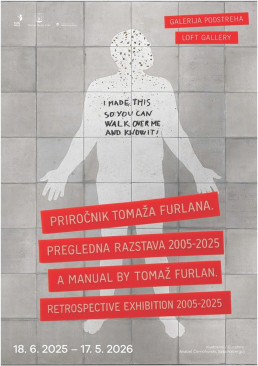
A Manual by Tomaž Furlan
A Manual by Tomaž Furlan
Retrospective Exhibition 2005–2025
Loft Gallery, Škofja Loka Museum, Škofja Loka, 18. 6. 2025 — 1. 10. 2026
Curators: Anabel Černohorski, Saša Nabergoj
A Manual by Tomaž Furlan, on view at three locations within the Škofja Loka Castle, covers the last twenty years of the artist’s work. The Loft Gallery features a selection of his works created between 2005 and 2025. Exhibited on the ground floor of Škofja Loka Museum is Furlan’s work Book (2010), which is part of the museum’s permanent art history collection. Nearby, in the video area of the Museum’s Living Room, visitors can watch a compilation of Furlan’s video performances titled Wear I–XVII (2005–2014).
A Manual by Tomaž Furlan, on display in the Loft Gallery, includes selected works from all three of the artist’s open-ended art series. The recurrent feature of Furlan’s Wear series (2005–) are interactive objects that the viewers are supposed to engage with through active participation. Thus, the series raises questions about the relationship between the artist, the artwork, the viewer and the institution. The Morning series (2019–) features various more or less everyday objects – even completely useless ones – offering reflection on usability and aesthetics in art. For the most part, the Walk series (2021–) is focused on the floor and its title hints at the fact that the works can be walked on. The exhibition, tailored specifically for this particular gallery space, includes works that had long existed only as ideas in the artist’s sketchbook. Some of them were being created on-site right up until the opening of this exhibition.
Tomaž Furlan is a sculptor and intermedia artist whose first artistic explorations date back to the early years of the new millennium – a time when technology was becoming more widely available. Getting his very first computer and digital camera significantly shaped Furlan’s early artistic expression. In addition to his interest in technology, film and home-made mechanisms, one of the focuses of his artistic practice was (his own) body. Other features that are characteristic of his entire oeuvre are a distinctive sense of humour and an interest in the way individuals are embedded in contemporary economic and social conditions.
All of the above comes together in Furlan’s distinctive Wear series, which he started working on circa 2005, while still in the midst of his sculpture studies. This series brings together robust, often wearable and, most of all, interactive objects made from recycled materials and found objects. Up until 2014, the series was largely characterised by video (performance) art – first as a stand-alone medium and later as some kind of bizarre video manual for the use of DIY devices (Wear V–VI–VII, 2005–2008). Since 2014, the series has made no use of digital technology (Wear XX, XXI, XXII, 2015), this, however, does not mean that the artist has given up the video format – it’s just no longer at the forefront of his artistic practice.
Circa 2019, Furlan’s work took an aesthetic turn, most evident in two of his series: Morning (Border Not Working, 2019), started that year, and Walk (I Made This So You Can Walk Over Me and Know It, 2021), which he has been working on since 2021. Although both series still incorporate waste materials or scraps and discarded objects (Useless Objects I–III, 2025), which have been a constant feature of his work since the beginning of his artistic career, stone and concrete are taking on an increasingly important role, suggesting a greater aesthetic potential (Scrapes, 2021).
The division of Furlan’s works into series is only one of the possible exhibition entry points. As his works are constantly built on and adapted to various exhibition venues and contexts, it is sometimes difficult to know exactly which series individual works belong to, because their characteristics are often intertwined. The categorisation stems from the artist’s inner need for order and classification, which in part is socially conditioned. Furlan, however, often approaches rules in a playful way – not only those that apply in art, but he also questions broader social constructs such as identity, borders and migrations (More Local Than Me, 2021; Border Not Working). Through his works and their titles, he often encourages viewers to reflect on social issues, also in relation to the past (All the Things My Grandfather Did I Am Not Allowed To, 2025) and even the future (Manual for a Home-made Spacecraft III, 2019–2025).
Sometimes it takes years for the ideas in Furlan’s sketchbook to be turned into art (Tunnel, 2025), at other times an everyday object suddenly becomes the foundation for a new work (Family Table, 2021), and sometimes a piece of art is a combination of both (Useless Objects). Furlan is no stranger to building on existing projects, transforming and adapting them to different exhibition spaces and contexts – this is certainly true of the project Manual for a Home-made Spacecraft III, which is the third edition of the same work and serves as a reference for the title of this exhibition.
The title reveals the essence of Furlan’s creative practice, which is based on the principle of DIY. Although his approach to art is unmistakably conceptual, most of his works are created by means of an intense, practical and handwork process, centred on the search for innovative solutions to the technical, building and construction challenges that the artist takes up himself. In doing so, he applies a wide range of skills acquired in his youth in his family’s stonecutter’s workshop, while doing various odd jobs and later as a restorer and sculptor.
Commentary on contemporary social and economic conditions – often delivered with humour, irony and self-irony – remains an important aspect of Furlan’s work. The retrospective spanning twenty years of the artistic activity of one of Slovenia’s most prominent conceptual artists is not chronological; it is shaped like a circular path, on which visitors get to walk aided by a guide with descriptions of the works revealing the various thematic segments of Furlan’s oeuvre.
As visitors to the exhibition, we transcend the usual relationship between the viewers and a work of art – we become a vital and integral part of it. Without our participation, many works do not fully come to life. This makes the need for an in-person gallery visit and a direct experience of art – one that goes beyond viewing art passively from a distance (on screens) – all the more evident. The opening piece titled I Made This So You Can Walk Over Me and Know It, used by the artist to directly address us as soon as we enter the gallery space, thus serves as an invitation to interact with the work and also as a call for our personal presence at the exhibition.
The text is taken from the website of the Loški muzej / Loft Gallery.


The Mother of All Struggles
The Mother of All Struggles
Overview exhibition, City Art Gallery Ljubljana
3. 12. 2024–16. 2. 2025
The exhibition encompasses the period from the beginning of his artistic career in 2000 to the present day, including Furlan’s latest production created specifically for the exhibition at the City Art Gallery Ljubljana. Over the past two decades, Furlan has established himself in the Slovenian and international art scene as the creator of the so-called cynical machines, objects, video works, and performances that are infused with socially critical content and ironic humour. His works focus on the issues of human labour in the era of automation and robotization, when humans are becoming increasingly more similar to machines. He addresses behavioural patterns within the context of daily routines and raises questions about the problem of repetitive and senseless tasks and the role of an individual’s body in contemporary society. He also stages and comments on various other pathological social conditions. The exhibition presents key phases in the artist’s creative development. Among other works, one of his most renowned and successful multi-year projects, the Wear series created from 2005 to 2015, which is a satire of the exploitation of workers in the era of neo-liberal capitalism, is also presented. The show encompasses the artist’s diverse creative areas, ranging from an expanded field of sculpture, kinetic objects, and installations to video, performance art, and an artist’s book.
Production: Museum and Galleries of Ljubljana
Curator and Text: Barbara Sterle Vurnik
Coordination and Production: Maruša Meglič
Design: Marko Damiš
Technical Implementation: Technical Service MGML
The project was made possible by: City of Ljubljana, Department of Culture
Thanks to the following for kindly lending works by Tomaž Furlan for the exhibition:
Art Collection Generali, Generali Insurance Company, d.d., Ljubljana; Modern Gallery (MG+) plus Museum of Contemporary Art Metelkova (+MSUM); Loški Museum Škofja Loka, Škofja Loka.
More on: City Art Gallery Ljubljana
Selection of Media Responses
Vojko Urbančič: »Tomaž Furlan: Humor je izrazito resna stvar«, Delo, 7. 12. 2024

Avant-garde is Empathy
Journey Through Arte Utile and Avant-garde is Empathy


Research Residency and exhibition
Raum AU, Slovenj Gradec, May 23, 2024 to July 26, 2024
The “Journey Through Arte Utile” is organized by the non-governmental organization Raum AU, in collaboration with the Carinthian Gallery of Fine Arts and the Ministry of Culture of the Republic of Slovenia. The research residency in the studio of Pino Poggi is a new concept for understanding the ideas and work of Pino Poggi. It is dedicated to interdisciplinary research and study of his extensive and complex body of work. In the first year, the project was explored by artists Tadej Pogačar and Tobias Putrih, followed by Vesna Bukovec and Ištvan Išt Huzjan in the subsequent year. This year, the journey begins with sculptor and intermedia artist Tomaž Furlan.
Tomaž Furlan on researching the archive of Pino Poggi and his useful art Arte Utile:
“What does avant-garde actually mean? This is the starting question for my installation as part of the Journey Through Arte Utile. Historically, it is clear: avant-gardes have been the driving force of social progress and platforms for exploring collective feelings, both aesthetic and political.
In reflecting on and formulating the installation, I focused on the importance of a broad reflection on social reactions. What is the role of art and the artist in processes of social change, and is the artwork a means of communication, a collective common point, or simply an object of desire?
If we are all Beuys’ artists, then there can be no barrier between the viewer and the artist. Their worlds are one, and interaction is inevitable. Avant-garde is empathy because it speaks of understanding the other, participation, and the need for collective work.”
The exhibition concluded on Friday, July 26, with an interactive de-installation with the artist.
Video of interactive de-installation of the exhibition

Shell
Shell

Forma Viva / Božidar Jakac Art Museum
Kostanjevica na Krki, Slovenia 2023
Forma Viva is certainly an interesting concept of artistic creation. The creativity stimulated by symposium creation, defined by time and local resources, encourages a wide range of ideas, working potentials and creative experiences. My reason for participating in the symposium was primarily to reflect on Forma Viva as a whole. Looking at the multitude of artistic solutions by different artists that are scattered around the surrounding parks and fields is a kind of overview of the social record through time and space. To materialise the reflection, critique and contemporary articulation of wooden sculpture seemed reason enough. Hopefully, Shell will bring a continuity of change in this historical record of artistic interventions.
Shell has been a tree from the beginning and will remain a tree. I am not interested in how to reshape and transform it into a new, unrecognisable form with the artist’s signature. The aesthetics of the natural is a complex ideal. I am interested in the interiority of substance, its duration and its passing. That is why I halved, hollowed out and filled this large log, the remnant of an even larger tree, with artificial material. A material that is becoming the bond of civilisation – concrete. In this way, its interior is permanent, and the shell of the tree is left to time and the forces of nature. The decay and absence of the wooden shell brought about by nature will reveal the artificial core, the construct of the tree’s memory and the anthropogenic nature of conservation.
More about Forma Viva on: Božidar Jakac Art Museum

I Made This
I Made This

Solo exhibition, Božidar Jakac Art Museum, former monastery church, Kostanjevica na Krki, Slovenia
24 September 2021-27 March 2022
The exhibition I Made This consists of spatial works created by Tomaž Furlan, sculptor and multimedia artist, who often addresses the complex relationships between humans, our environment and the everyday banalities. His latest work consists of a series of objects, with which he directly, materially and self-reflectively addresses the social dynamics between the so-called civilised society and its most common accessories. A series of sculptures, installations and spatial interventions created from robust materials, such as stone, terazzo concrete, marble and wood are on display in the Former Monastery Church.
Tomaž Furlan’s artistic practice is deeply interwoven with a humorous and ironic attitude to situations that an individual might face in his everyday life and that he is, in the spirit of the times, forced to solve in the manner of optimal efficiency. In 2005 he started constructing a series of absurd machines that share the name Wear, in which sculptured objects are used as body extremities and elements of set design in video performances. His sculptures and installations question the society of unavoidable effectiveness, in which there is no space for useless objects that do not have a practical and potentially monetary value. Furlan continues to question this topic in his most recent artworks. Within this exhibition he addresses the omnipresent idea of ‘common sense’, which is supposedly the criterion for rationality and efficiency. As a result, he presents seemingly trivial objects, which (possibly subconsciously) govern human lives. In his recognisable style, interwoven with self-irony and distanced from his own position, he exposes the absurdity of objects he created and the ideas that they represent. Due to their questionable functionality these seemingly common objects can be understood as merely (useless) works of art.
Miha Colnar
More on: Božidar Jakac Art Museum

Until Morning!
Until Morning!

Solo exhibition, Alkatraz Gallery, AKC Metelkova Mesto, Ljubljana, Slovenia
8 September 2020 – 30 September 2020 “Here I am again. I’m running out of time; the sketch book is full of ideas I don’t remember. The studio is full of trash, I’ve got coffee and milk, the evening is approaching. There’s another long night in front of me. Until morning, the next Wear has to be finished! Until morning! Wear VIII!!” Tomaž Furlan’s retrospective exhibition entitled Until Morning! presents a selection of the artist’s work of the past decade. Primarily, it is composed of two series, namely: Wear (VII-XXII), a series of absurd performative devices, predominatly welded together from parts of iron found by chance; and Morning, a more recent, formally more sculptural series. Tomaž Furlan, otherwise, is an academic sculpturer and a renowned artist, a recepient of The OHO Young Visual Artist Award and The Jakopič Recognition Award. In addition to his artistic work, in the past decade, and alongside his physical work including restoration, he also worked as a director of a youth centre and as a youth worker. He currently works part-time as an assistant at The Academy of Fine Arts and Design, University of Ljubljana (ALUO), and as an occasional caretaker and postman there. Furlan grew up in a stonemason family from Škofja Loka, and it is precisely his craftsmanship background that essentially determined his decision to professionally choose art: ‘I was searching for a profession, where I would not be able to find its absolute knowledge. As Einstein said that an expert is someone who has made all mistakes in a certain area, I was searching for a profession where this would not be possible, and art is this kind of a profession, for sure. Art today has no climax.’ Furlan emphasizes the fact that he is both a caretaker and a professor at The Academy with a pround whine. A similar duality can be identified in his works from the series Wear. It is composed clumsily (and hysterically). Its artpieces appear rough and sophisticated at the same time. They are grotesquely realistic, with a certain comic component – one can either contemplate them or laught at them, although mostly one does both. Thus, it comes as no surprise that Furlan’s influences include both Marina Abramović and Charlie Chaplin, as well as Lars von Trier. The series Wear was being produced at the last minute, mostly during the night, a day or two before the exhibition. On the contrary, the series Morning is more deliberate, less impulsive, and conceived more long-term. Wear and Morning were created during the night and in early morning hours before Furlan starts work at The Academy, respectively. In terms of form and style, the two series in question are diametrically opposite. The past decade of Furlan’s life and work can be seen as a move from the night to the day – from being one of thousands to be cheated out of pay during construction industry crisis, to the present day being an established artist on the way of becoming a professor at the university. Nonetheless, the crisis has been accompanying him throughout, it made him stronger, and he internalised it: ‘Nothing can be so bad that it can’t be worse, the worst case scenarios have been realising all the time; which is not completely true, but the feeling never goes away.’ It is characteristic of Furlan that his works are created for exhibitions, just before their openings. After he receives an invitation, he waits for an inspiration, which is born just before the exhibition, out of agony. The works in Wear were thus created in a zealous way. Their ‘use’, too, requires zeal, but here is the catch; Furlan’s works are interactive in the most primary sense of the word: both in the way of production and consumption (usage), they lack distance. Thus, the paradox reveals itself: Furlan’s works are impersonal precisely in that they lack distance. What we see is what we do. Something similar can be said about Tomaž Furlan. We all know that his art is ingeniuos, but no one can say why precisely – his genius is visible at first glance, but it is also impossible to overlook. His artistic works possess not only freshness, humour, and abusurdity, but also incite a moment of wonder and vulgar sublimity. It is similary painful to interpret his works, as the interpretations vary from art history to useless theory in the sense of ‘he is interested in the material’ or ‘postfordism’. The artist himself best defines his works, when he talks about Wear XVII: ‘It is an attempt at fighting banality with stupidity.’
Miha Turk
More on: Alkatraz Gallery

Under the Surface, ARCOMadrid
Under the Surface, ARCOMadrid

Art fair ARCOMadrid, collaboration with P74 Gallery
26 February – 1 March 2020
P74 Gallery proudly presents a dialogue between two remarkable artists of different generations: the innovative practice of the young Tomaz Furlan and the post-conceptual practice of the middle-generation Joze Barsi. In their work, they both deal with objectness (Barsi: from the deconstruction of the sculptural object in the mid-1990s to a shift to architectural explorations of space and their subsequent expansion into installation), the autonomy of the subject, and individualization. The title Under the Surface implies synonyms such as “basement”, “depths”, “belly”, “ground”, “groundwork”, “pedestal”, “rest”, “substructure”, etc. Tomaz Furlan and Joze Barsi both show a specific interest in the strategies of re-use: Furlan in the construction processes of his “machines” and Barsi in the post-conceptual re-examination process of copying the overlooked and ignored texts of political philosophy and art.
More on P74 Gallery

Breakfast on a morning train
Breakfast on a morning train

Samostojna razstava, Galerija ŠKUC, Ljubljana
21.11. – 13.12.2019
»Je avto objekt ali socialni simbol? Je čakanje v vrsti produkcijski proces ali kontemplativno dejanje? Je obuvanje nogavic eksistencializem ali konvencija?« se sprašuje Tomaž Furlan ob aktualni razstavi, ki (razen enega) vključuje popolnoma nova dela. Čeprav vsako od njih vsebuje lastno sporočilnost, je treba gledati predvsem postavitev v celoti. Ta se osredotoča na izsek vsakdanjega jutra povprečnega posameznika, ko se sooča s sliko sveta. Avtorja zanima posameznikov osebni pogled na objekt – trenutek v percepciji, ko gre za razumevanje vseh razsežnosti oblike in ne le njene konstrukcije. Na razstavi tako išče banalne konotacije med objekti in njihovo pasliko oziroma se ukvarja z njeno popačenostjo, ki jo povzroči individualna interpretacija. Gre za nadaljevanje avtorjeve refleksije družbene dinamike, pogled v civilizirano okolico in njene pripomočke. Tomaž Furlan opiše razstavo tudi kot »slike ponedeljkovega jutra, kjer je vsak prostor svoj kader oziroma slika«.
Odnos med človekom in okoljem je glavna tema celotne avtorjeve umetniške prakse, naslov razstave pa povedno oriše današnje stanje. Produkcijski proces ni le aktivnost samega proizvajanja, temveč tudi vse ostalo, v kar je vpet posameznik (njegovo gibanje v družbenem okolju), tako racionalizacija časa kot učinkovitost ter kolektivnost in participatornost. Naslov razstave obenem asociira tudi na naslov slike Edouarda Maneta Zajtrk na travi (1863), eno od prelomnih del umetnostne zgodovine. Kompleksna vsebina je pomembna (v grobem) zaradi monumentalnega načina prezentacije vsakdanje teme, kjer je v žanrski prizor vključen ženski akt, sicer rezerviran za slike z mitološko ali alegorično vsebino. Pa vendar – Manet naslika meščanstvo, ki zajtrkuje na travi, Tomaž Furlan pa nam »slika« mobilno meščanstvo. Njegova vpetost v produkcijsko in družbeno rutino, ki je vedno bolj prisotna tudi v zasebnih prostorih, vendar je bolj kot na zunanje sistemske mehanizme vezana na posameznikovo izbiro, ki se na videz zdi svobodna in osebna.
Nina Skumavc
Več na Galerija Škuc

Artist is on vacation!?
Artist is on vacation!?

Solo exhibition, Night Window Display Gallery Pešak, AKC Metelkova mesto, Ljubljana, Slovenia
7 September – 6 October 2019
»Artist way of life« is changing phenomenon in the modern history. Bohemian tired from turpentine and alcohol vapors, activist exhausted from the political and autodestructive practices, artist drained from the poverty and constant chase for the truth, businessman, misunderstood genius or some other form of obtained identity.
What has a bigger significance? An art or an artist? Is the artist’s lifestyle indicating the value of art?
Can artist existence be the point of view for the artistic content? Is artist always present as for example Marina Abramović?; is everyone an artist as stated by Joseph Beuys?; does artist goes to vacation?
Installation “Artist on vacation!?” speaks of the artist 24/7, also when he is not on a pedestal.

Rihard Jakopič Honorable Mention
Rihard Jakopič Honorable Mention
Museum of Contemporary Art, Ljubljana
April 12, 2017
Named after Rihard Jakopič an important Slovene impressionist painter, the Rihard Jakopič Award is the highest award in the field of fine arts in Slovenia. The Prize and Honorable Mentions are awarded by the Association of Slovene Fine Artists Societies, the Academy of Fine Arts and Design in Ljubljana, Moderna galerija and the Slovene Association of Art Critics.
The recipient of the 2017 Rihard Jakopič award for life achievement is an academic painter, Marjan Gumilar. The recipients of the 2017 Rihard Jakopič honorary mentions are artists of the younger generation for their achievements in individual projects in the field of contemporary art. The recipients are academic sculptor Tomaž Furlan and multidisciplinary artist Tanja Lažetič.
More on: Museum of Contemporary Art